
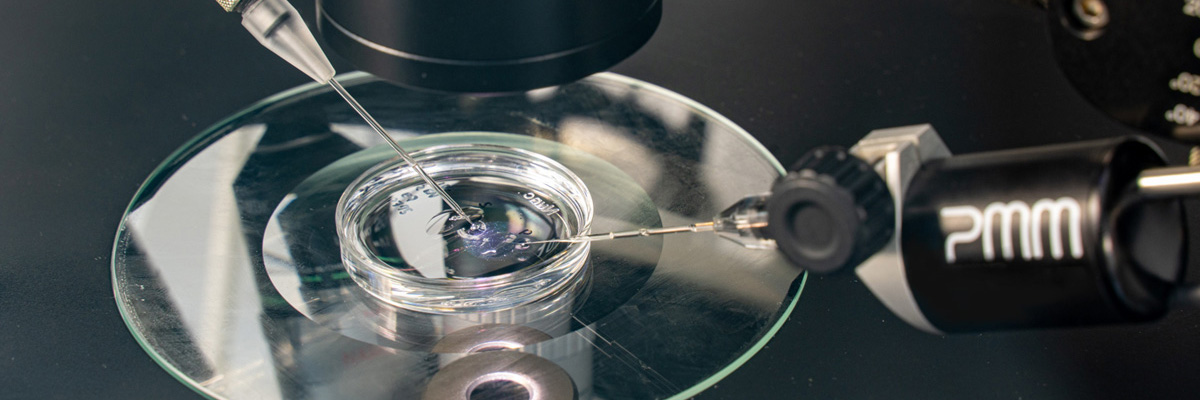
What is ICSI?
ICSI is a technique to inject a single sperm directly into the cytoplasm of the egg. ICSI was developed to assist fertilisation when sperm quality is particularly poor. Over the decades, ICSI has advanced into a more effective and reliable procedure. It is the preferred method for fertilisation in most ART centres around the world. ICSI is a technique that involves the direct injection of a single sperm into an egg using a fine needle. ICSI is most useful for couples who suffer from severe male factor infertility as it bypasses the initial steps of gamete interaction. As ICSI is a skill-based procedure, the expertise of the embryologist plays a significant role in ensuring good fertilisation. The entire process is done under microscopic visualization and micromanipulation using precision-based equipment. Healthy sperm is chosen and immobilised before being delivered into the egg’s cytoplasm.
How does it work?
Conventional ICSI (Diagram)

A. A sharp pipette is advanced into the egg’s shell and membrane.
B. The egg cytoplasm is aspirated into the pipette to break the membrane.
C. The cytoplasm contents and sperm are released before removal of the pipette.
