
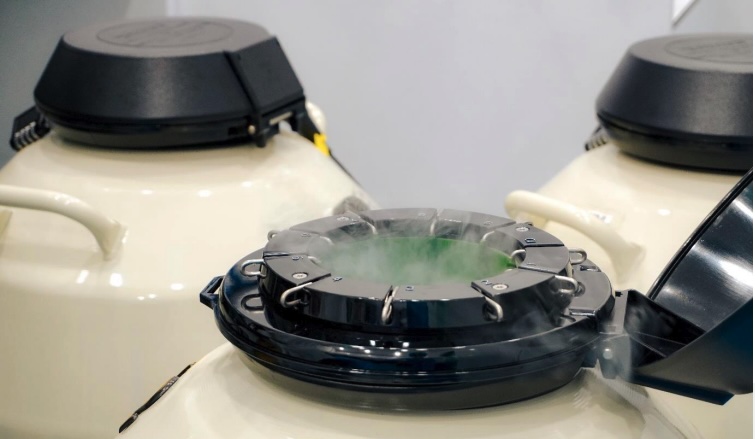
Over the last few decades, in-vitro fertilisation (IVF) technology has made great strides. One such technology is in embryo cryopreservation, which plays an important role in most IVF programmes. Embryo cryopreservation is the process where embryos are frozen and stored in special cryotanks until they are needed at a later time. It is similiar to the concept of ‘stopping the clock’ –where the embryo pauses its development and remains dormant in a frozen state. Once the embryos are thawed, the ‘clock resumes’ and the embryos continue its growth.
Why is embryo cryopreservation done?
The most obvious benefit of embryo cryopreservation is that usable embryos can now be stored, which otherwise, would have been discarded. Embryo cryopreservation has also increased the successfulness and safety of IVF by:
1. Ensuring a receptive uterus before transfer
– In an fresh cycle, the uterus environment may be affected due to hormone injections given to stimulate the growth of follicles. By freezing embryos, it allows for better preparation of the endometrium to increase chances of implantation.
2. Increasing safety for women at risk of OHSS
– Existing Ovarian Hyperstimulation Syndrome (OHSS) symptoms can be worsened by pregnancy, hence, freezing embryos and deferring a fresh transfer lower the risks for OHSS.
3. Enabling genetic testing of embryos
– The results from genetic testing (PGT-M and PGT-SR) may take several weeks before being released, depending on the genetic laboratory’s schedule. Therefore, the embryos must be frozen beforehand.
Basic principle of embryo cryopreservation
The embryo comprises of many cells which are made up mostly of water. How embryo freezing works is by replacing the water in cells with cryoprotectant solution, also known as “anti-freeze” before the embryo is brought into extremely low temperatures in liquid nitrogen. Cryprotectant prevents the formation of ice crystals that are harmful to cells. There are two types of freezing methods, called slow freezing and flash-freezing (“vitrification”). Without going into specifics, vitrification is now the preferred choice of most centres worlwide, including ours.
What are the survival rates of embryos after cryopreservation?
With current vitrification methods, almost all good-quality embryos and blastocysts survive the freezing and thawing process. Embryo quality shouldn’t differ too much as when compared to before freezing. On the other hand, blastocysts of poorer quality with fewer intact cells are more susceptible to cryo-damage. As cryopreservation involves the exchange of fluid, blastocysts would collapse and expand during the freeze-thaw process. Embryo thawing is usually performed several hours before the transfer. A good sign of viability is the continous expansion of the blastocyst—where the duration for reexpansion may differ between each blastocyst.
How long can embryos be stored for?
Under the revised Assisted Reproduction Services regulations in Singapore, couples who wish to extend the storage beyond 10 years must provide consent to the IVF centre. Do note that there will be an annual fee for the upkeep of embryo storage.
Is the embryo cryopreservation process safe for the resulting baby?
Studies have shown that babies born after embryo cryopreservation have acceptable safety profiles in obstetric outcomes (birthweight, pre-term rate, birth defects) when compared to the fresh embryo counterpart [1] .
References
1. Wennerholm, U. B., Söderström-Anttila, V., Bergh, C., Aittomäki, K., Hazekamp, J., Nygren, K. G., Selbing, A., & Loft, A. (2009). Children born after cryopreservation of embryos or oocytes: a systematic review of outcome data. Human Reproduction, 24(9), 2158–2172.
