
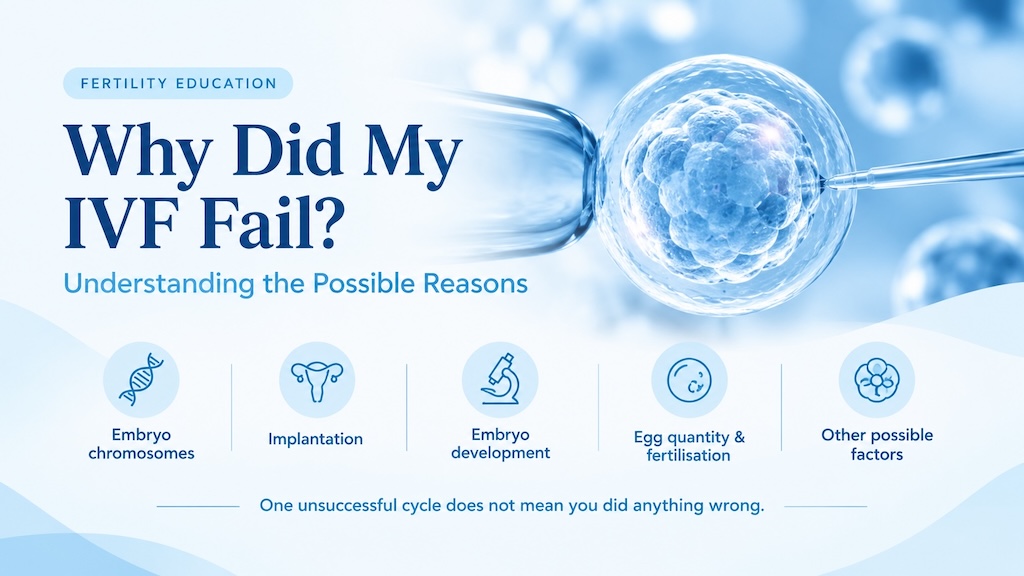
After the injections, appointments and waiting for a pregnancy test, a failed IVF cycle can be difficult to process. You may wonder why it happened or whether you could have done something differently.
IVF has several steps, and a cycle can be unsuccessful at any stage. Eggs may not fertilise, embryos may stop growing, or a transfer may not lead to pregnancy. Sometimes there is a possible explanation; sometimes the reason remains unclear. The result alone does not mean you did something wrong. [1]
Your chances depend on factors such as age and the cause of infertility. One unsuccessful transfer does not automatically mean there is an ongoing implantation problem. [1,2]
At Alpha IVF Singapore, we believe understanding the possible reasons why IVF fails can help you process your experience and plan your next steps with clarity. Here are the most common reasons why IVF can fail.
Reason 1 Changes in the embryo’s chromosomes
Chromosomes carry genetic information. Some embryos have an unexpected number of chromosomes, which can affect their ability to develop, attach to the womb or continue growing during pregnancy. This becomes more likely as the age of the eggs increases. [3]
An embryo may look suitable for transfer under the microscope and still have a chromosome change. However, a negative pregnancy test cannot tell us whether this was the reason the IVF cycle failed. [3]
Reason 2 The embryo did not attach to the womb
For pregnancy to begin, an embryo needs to attach to the lining of the womb. This is called implantation. Polyps, certain fibroids or scar tissue inside the womb may affect this process. Your doctor may also review the lining and the medicines used to support it. [2]
A scan may help identify a problem. Further checks depend on your history and findings; they are not automatically needed after one unsuccessful transfer. [2]
Reason 3 Embryos stopped growing before transfer
Some embryos stop developing in the laboratory before they are ready for transfer. Egg and sperm factors, or chromosome changes in the embryo, may contribute. Your doctor can go through the laboratory report to explain how your embryos developed, although it may not reveal an exact cause. [1,3]
Reason 4 Fewer eggs were collected than expected
The medicines used during IVF encourage several eggs to mature. Sometimes the ovaries respond less than expected, so fewer eggs are collected. This can leave fewer opportunities for fertilisation and embryo development. [1,4]
Your age, egg reserve and response to previous treatment help guide the review. An AMH blood test can help estimate how your ovaries might respond, but it does not directly measure egg quality. Low AMH alone does not mean pregnancy is impossible. [4]
Your doctor may discuss whether changing the medicines or doses is appropriate, and what that change could realistically achieve. [4]
Reason 5 Eggs did not fertilise as expected
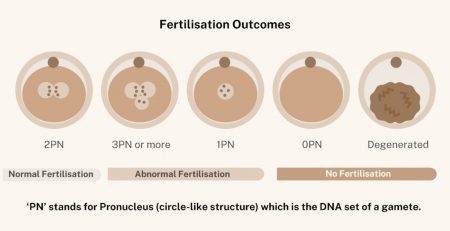
Not every collected egg is mature, and not every mature egg fertilises. Egg and sperm factors can play a part. [1,5]
For some patients, ICSI may be considered. This involves injecting one sperm into an egg and may be relevant to certain sperm problems or previous low or failed fertilisation with conventional IVF. It does not guarantee fertilisation or a baby. [1,5]
Do you need more tests after IVF failure?
More tests do not always mean clearer answers or a better chance of pregnancy. Some additional tests have limited or uncertain evidence that they improve the chance of having a baby. Ask your doctor what a test could tell you, whether the result would change your treatment, and what evidence supports its use for you. [6,7]
What to ask your doctor after a failed IVF cycle?
A follow-up appointment can help you understand what happened and consider your options. You could ask:
- At which stage did the cycle become unsuccessful?
- How many eggs fertilised, and how did the embryos develop?
- Were there any concerns about the womb lining or embryo transfer?
- Would more tests change the treatment plan?
- What are my options, and what are the benefits and risks?
You can take time to decide whether and when to continue treatment. Counselling or emotional support may also help you work through the experience. [1]
Your next steps with Alpha IVF Singapore
At Alpha IVF Centre & Alpha Women’s Specialists Singapore, you can discuss your previous IVF cycle and the options relevant to you. If you had treatment elsewhere, bring your treatment records and laboratory reports to help guide the discussion.
A review may help you decide what to do next, even when it cannot identify an exact cause or predict the outcome of another cycle.

Medically Reviewed By: Dr Yu Su Ling, Consultant Obstetrician & Gynaecologist and Fertility Specialist at Alpha IVF & Women's Specialists Centre, where she also serves as Clinical Governance Officer. Dr Yu specialises in IVF, infertility, gynaecological endocrinology, and menopause management. Her research interests include intrafallopian tube catheterisation, growth hormone augmentation in IVF, and ovarian tissue transplantation.
References
1. HFEA. In vitro fertilisation IVF
https://www.hfea.gov.uk/treatments/explore-all-treatments/in-vitro-fertilisation-ivf/
2. ESHRE. Recurrent implantation failure recommendations 2023
https://www.eshre.eu/Guidelines-and-Legal/Guidelines/RIF
3. ASRM. Preimplantation genetic testing for aneuploidy 2024
https://www.asrm.org/practice-guidance/practice-committee-documents/the-use-of-preimplantation-genetic-testing-for-aneuploidy-a-committee-opinion-2024
4. ASRM. Testing and interpreting measures of ovarian reserve 2020
https://www.asrm.org/practice-guidance/practice-committee-documents/testing-and-interpreting-measures-of-ovarian-reserve-a-committee-opinion-2020/
5. ASRM. ICSI for nonmale factor indications 2026
https://www.asrm.org/practice-guidance/practice-committee-documents/intracytoplasmic-sperm-injection-for-nonmale-factor-indications-a-committee-opinion-2026/
6. HFEA. Endometrial receptivity testing
https://www.hfea.gov.uk/treatments/treatment-add-ons/endometrial-receptivity-testing/
7. HFEA. Microbiome testing
https://www.hfea.gov.uk/treatments/treatment-add-ons/microbiome-testing/







Leave a Reply
You must be logged in to post a comment.