
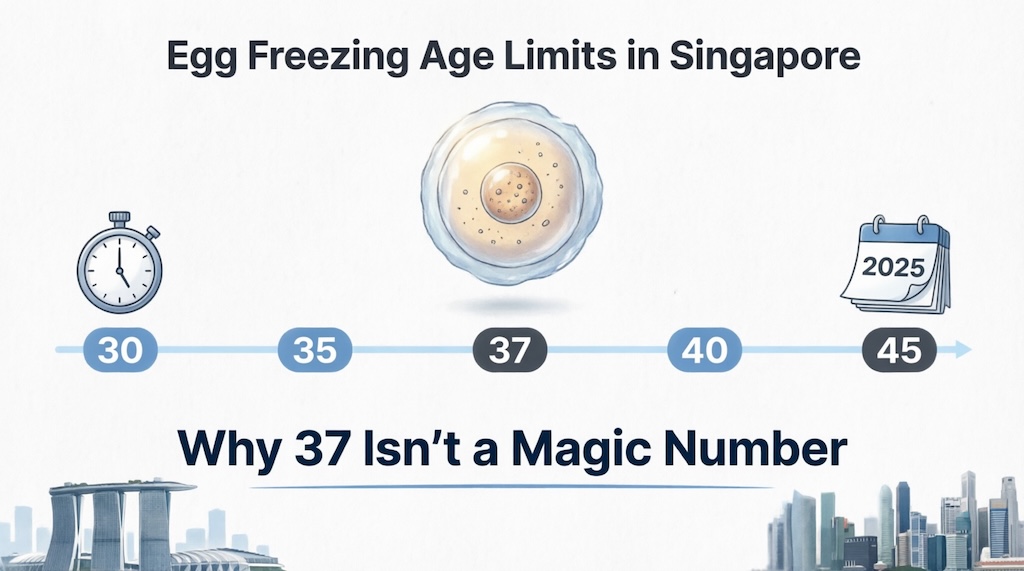
The 37-Year-Old Question
If you’re a woman in Singapore in your late 30s thinking about egg freezing, you’ve probably asked yourself this question: why is the age limit 37? And what happens if you’re 38?
This question comes up so often that it even made its way to Parliament. Each year, about 40 women above 37 apply to MOH for permission to freeze their eggs. Around 70% of these appeals get approved, based on each woman’s individual circumstances (1).
Here’s the truth: 37 is a legal cut-off, not a biological one. Your fertility doesn’t suddenly drop the moment you turn 37. It’s a gradual decline that starts years earlier. This guide walks you through the science, the numbers, and what they really mean for you.
Understanding Ovarian Reserve Decline in Singapore
Every woman is born with all the eggs she will ever have. From that point on, two things change over time: how many eggs remain (egg quantity) and how healthy those eggs are (egg quality) (2).
Egg loss happens naturally every month, and the pace picks up after age 35. By the late 30s and early 40s, egg supply is noticeably reduced. At the same time, older eggs are more prone to chromosomal abnormalities, which is part of why women over 35 tend to see higher miscarriage rates and lower pregnancy rates (2).
Associate Professor Sadhana Nadarajah, who heads KK Women’s and Children’s Hospital’s (KKH) department of reproductive medicine, puts it simply: as women age, both the number and quality of their eggs decline, which makes retrieving enough eggs for a live birth increasingly challenging (2).
This is ovarian reserve decline in a nutshell, and it’s the biological backdrop behind Singapore’s egg freezing age limit.
Why the Egg Freezing Age Limit in Singapore Is 37
When elective egg freezing was first announced in Singapore in 2022, the proposed cut-off was 35 (3). But MOH continued reviewing local and international evidence and found that success rates for egg freezing stay relatively stable up to age 37. Past that point, success rates using eggs frozen after 37 continue to decline (3).
The 37-year limit was chosen to give women a reasonable chance of success, while still encouraging them to think seriously about their fertility timeline (3).
The “Signal” Behind the Policy in Singapore
Minister Ong Ye Kung explained this reasoning in Parliament: removing the age limit entirely wasn’t advisable, since egg quality declines over time and the limit itself serves as an important reminder for women to consider freezing earlier rather than later (4).
In other words, the age limit isn’t only a rule; it’s a nudge. Take it away, and some women might delay egg freezing under the impression that they can always do it “later,” when success rates would be far lower by then (4).
What Egg Freezing Success Rates by Age Really Show
Numbers help put things in perspective. A predictive model cited in a 2024 editorial published in the Annals, Academy of Medicine, Singapore (January 2024) estimated that a 37-year-old may require approximately twice as many mature eggs as a 34-year-old to achieve the same modelled chance of at least one live birth (5).
Estimated Number of Mature Eggs for a Modelled 75% Chance of at least one live birth:
| Age at Freezing | Eggs Needed for 75% Chance of Live Birth |
| 34 | About 10 eggs (5) |
| 37 | About 20 eggs (5) |
| 42 | About 61 eggs (5) |
Of course, success isn’t only about the number of eggs frozen; it’s about the entire journey afterwards, from thaw to fertilisation, embryo development, and eventually implantation (6). Each stage carries its own odds, and age affects every one of them.
Research consistently shows that outcomes are generally more favorable when eggs are frozen at a younger age. However, published figures vary depending on factors such as the number of mature eggs frozen, the laboratory, fertilization method, age at egg freezing and age at embryo transfer. For this reason, population-level estimates should not be treated as a prediction of an individual’s outcome.
What Happens at 38 and beyond?
Live birth rates decline meaningfully after 37. For women under 30, egg freezing offers only a modest improvement (about 3%), since most can conceive naturally anyway. The sweet spot is 30 to 35, where egg freezing offers the greatest benefit. From 36 to 37, the odds are still reasonable. Beyond 37, the expected benefit of elective egg freezing generally decreases when the eggs are collected at that later age. The age at which the eggs are frozen remains important, while the woman’s age and health when the eggs are eventually used may also affect pregnancy outcomes.
The Appeal Process
If you’re above 37 and still want to freeze your eggs in Singapore, you can appeal to MOH. About 40 women do so each year, and roughly 70% are approved based on individual circumstances. There’re no fixed published criteria, so each case is assessed on its own merits (1).
Considerations for Older Women
If you’re considering egg freezing after 37, a few things are worth keeping in mind. You may need more than one cycle to bank a sufficient number of eggs (9). Success rates are lower, so it helps to go in with realistic expectations (9). And because frozen eggs are typically used later, your health during a future pregnancy matters too; pregnancy in the late 40s carries higher risks, which is worth discussing with your fertility specialist ahead of time (9).
Is It Ever “Too Late”?
Not necessarily, but the odds do get harder. If you’re weighing your options, here’s what’s worth doing:
- Start with an AMH test. This simple blood test provides information about ovarian reserve and helps estimate how the ovaries may respond to stimulation. However, AMH does not directly measure egg quality or predict an individual’s chance of natural conception (10).
- Think through the timing of use. In Singapore, frozen eggs can only be used within a legal marriage (11). Even if you freeze at 38, you may not use them until your 40s, when pregnancy carries more risk.
- Be realistic about the process. Older women often need multiple cycles to bank enough eggs for a reasonable chance of success, so it’s worth having an honest conversation with your specialist about what that journey might look like for you (9).
- Understand that freezing preserves potential, not a guarantee. Even eggs frozen at a younger age still need to survive the thaw, fertilise successfully, develop into healthy embryos, implant, and carry through to a healthy pregnancy (7).
Key Takeaways
| Factor | What You Need to Know |
| Age 37 is a legal limit, not a biological cliff | Fertility declines gradually, but the pace picks up after 35 (2) |
| Success rates drop noticeably after 37 | A predictive model estimates that a 37-year-old may require approximately twice as many mature eggs as a 34-year-old for the same modelled chance of live birth (5) |
| The appeal process is available | About 70% of appeals are approved, though success rates remain lower even when approved (1) |
| Older women may need more cycles | Banking enough eggs can take multiple rounds of treatment (9) |
| Managing expectations matters | Freezing is about preserving potential, not guaranteeing an outcome (7) |
The Bottom Line from Alpha IVF Singapore
Egg freezing can be a powerful tool for preserving fertility, but age plays a significant role in how well it works. The best age to freeze eggs is generally before 35, when egg quality and quantity are at their highest (2). Freezing between 35 and 37 still offers a reasonable chance of success, though the odds continue to shift after that (5).
If you’re above 37 and considering egg freezing in Singapore, you still have options, including the appeal process through MOH (1). What matters most is understanding the science, knowing what realistic success looks like, and making a decision that feels right for you (5, 10).
Understand Your Personal Fertility Timeline
Not sure where your ovarian reserve stands? A Fertility Assessment at Alpha IVF Singapore can help. We’ll test your AMH levels to understand your egg supply (10), walk you through your personal fertility timeline (2), and explain your options, including whether egg freezing may be suitable and available based on your age and circumstances (1, 3), to help you make an informed decision based on your unique situation.
Age 37 isn’t a magic number; it’s a guide. Understanding your own biology is the real key to making empowered decisions about your fertility.
Disclaimer: This article is for informational purposes only and does not constitute medical advice. Please consult a qualified fertility specialist for advice specific to your situation.

Medically Reviewed By: Dr Yu Su Ling, Consultant Obstetrician & Gynaecologist and Fertility Specialist at Alpha IVF & Women's Specialists Centre, where she also serves as Clinical Governance Officer. Dr Yu specialises in IVF, infertility, gynaecological endocrinology, and menopause management. Her research interests include intrafallopian tube catheterisation, growth hormone augmentation in IVF, and ovarian tissue transplantation.
References
- Ministry of Health, Singapore. “Approval Rates for Egg Freezing Applications Among Women Above Age 37 and Consideration to Remove Age Limit.” https://www.moh.gov.sg/newsroom/approval-rates-for-egg-freezing-applications-among-women-above-age-37-and-consideration-to-remove-age-limit/
- Thomson Medical. “Egg Freezing in Singapore: Age, Success Rates, & Process.” https://www.thomsonmedical.com/blog/egg-freezing-singapore
- Ministry of Health, Singapore. “Raising of Age Limit from 35 to 37 Years for Egg Donors and Elective Egg Freezing.” https://www.moh.gov.sg/newsroom/raising-of-age-limit-from-35-to-37-years-for-egg-donors-and-elective-egg-freezing/
- Telescope.gov.sg. Parliamentary Transcript (8 April 2026). https://telescope.gov.sg/transcript/29029
- Chin HMS, Rajesh H. “Freezing Hope: Balancing Realism and Optimism in Elective Egg Freezing.” Annals, Academy of Medicine, Singapore. 2024;53:3-5 https://staging.annals.edu.sg/download/30398/
- Daniel Koh Clinic. “Elective Egg Freezing in Singapore: A Step-by-Step Guide.” https://www.danielkohclinic.com.sg/post/elective-egg-freezing-in-singapore-a-step-by-step-guide
- Progyny. “Egg Freezing: Frequently Asked Questions.” https://progyny.com/education/egg-freezing-frequently-asked-questions/
- Dr. Senai Aksoy IVF. “How many eggs do you really need to freeze?” https://draksoyivf.com/blog/how-many-eggs-to-freeze-for-baby-success/
- Roland Chieng Fertility & Women Care. “Elective Egg Freezing in Singapore.” https://fertilitycentre.com.sg/elective-egg-freezing-singapore/
- Zora Health. “AMH Test in Singapore: Cost, Clinics & What Your Results Mean.” https://zorahealth.co/insights/fertility-resources/amh-test-singapore/
- White Paper on Singapore Women’s Development (2022). https://www.scwo.org.sg/wp-content/uploads/2022/03/White-Paper-on-Singapore-Womens-Development.pdf








Leave a Reply
You must be logged in to post a comment.