
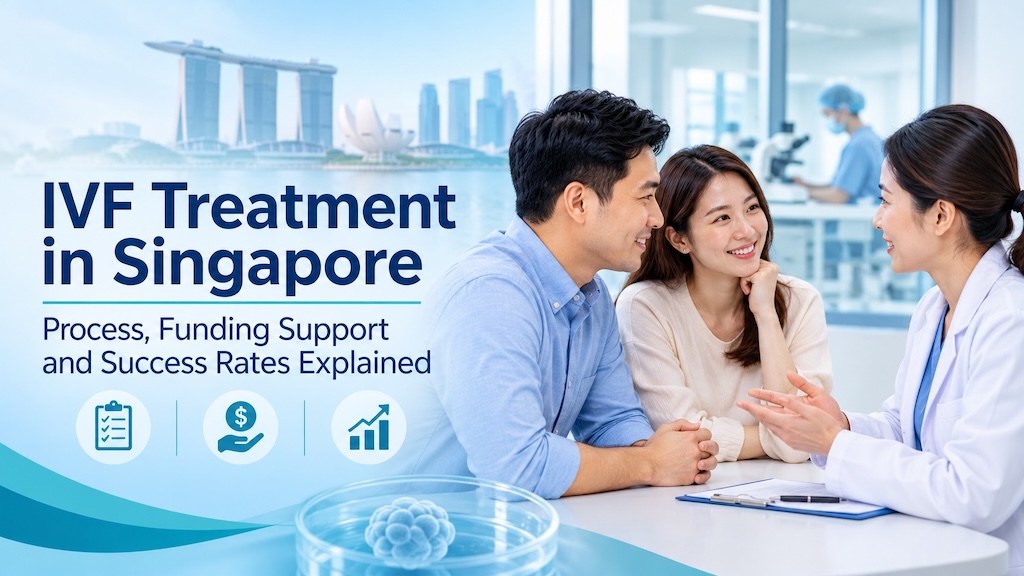
If you and your partner have been trying to conceive without success, IVF treatment may be one of the options your doctor discusses with you. In Singapore, IVF is a well-established treatment offered at both public and private centres, and government support is available to help with the cost.
But what does IVF actually involve? And what are your realistic chances of success?
This guide walks you through the IVF treatment process, the financial support available in Singapore, and what national data says about success rates.
What Is IVF Treatment?
In-vitro fertilisation (IVF) is a fertility treatment where an egg and sperm are combined in a laboratory to create an embryo. The embryo is then placed into the woman’s womb to support a pregnancy.
IVF is usually recommended for conditions such as damaged fallopian tubes, endometriosis, ovulation problems, unexplained infertility and male sperm disorders. Your fertility specialist will advise whether it suits your situation.
The IVF Treatment Process: Step by Step
At Alpha IVF Singapore, IVF treatment follows a structured process. Here’s what to expect.
1. Counselling and Consent
Before you start, your fertility specialist and a counsellor will explain the procedure, what it involves and what outcomes to expect. You’ll have the chance to ask questions before giving your written consent.
2. Pre-Treatment Preparation
You and your spouse will have blood tests for infectious diseases, including HIV, hepatitis B and C, and syphilis. A semen analysis for the husband and a rubella antibody test for the wife may also be needed.
3. Ovarian Stimulation
For about two weeks, the wife receives hormone injections to help the ovaries produce several eggs. There are two main protocols: the antagonist (“short”) protocol, which uses fewer injections and is more commonly used, and the agonist (“long”) protocol. Your doctor will recommend one based on your medical history.
Alpha IVF Singapore also offers Progestin-Primed Ovarian Stimulation (PPOS), which replaces some of the injections with oral medication. PPOS may be considered for patients undergoing egg freezing, those at risk of ovarian hyperstimulation syndrome (OHSS), or those planning a frozen embryo transfer. Your doctor will advise if it suits you.
4. Egg Retrieval
When your follicles are ready, a trigger injection is given. About 36 hours later, the egg retrieval is done under sedation. It takes about 15 minutes, and you can usually go home the same day.
5. Fertilisation and Embryo Development
In the laboratory, the eggs are combined with sperm using either standard IVF, where sperm and egg mix naturally, or ICSI, where a single sperm is injected directly into the egg. ICSI may be recommended when sperm count or quality is low.
We also offer Physiological Intracytoplasmic Sperm Injection (PICSI), which selects sperm based on their ability to bind to hyaluronic acid, a feature linked to sperm maturity. Whether PICSI is suitable depends on your individual circumstances, and your doctor can explain what the current evidence shows.
6. Embryo Transfer
The most suitable embryo(s) are placed into the womb using a fine catheter. This is usually painless and takes just a few minutes. You can usually go home about 30 minutes later.
Paying for IVF in Singapore: Medisave and Government Co-Funding
Many couples ask about IVF cost in Singapore. Fees differ between centres and depend on your treatment plan, so our team can go through this with you during your consultation. There are also two main forms of financial support to know about.
Medisave can be used for IVF at MOH-approved centres, up to set withdrawal limits: $6,000 for the first cycle, $5,000 for the second, and $4,000 for the third and later cycles. A lifetime limit of $15,000 per patient applies.
Government co-funding is available to eligible couples at public hospitals and covers up to 75% of Assisted Reproduction Technology (ART) treatment costs, subject to caps. For Singapore Citizen couples, the caps are up to $7,700 for a fresh cycle and up to $2,200 for a frozen cycle. Eligibility criteria apply, including the woman’s age and the couple’s citizenship status.
Note: Co-funding is only available at public hospitals. Patients at private centres can still use Medisave but aren’t eligible for government co-funding. Scheme details can change, so please check the latest information on the Ministry of Health (MOH) website.
Source: Ministry of Health, Singapore, Marriage and Parenthood Schemes (updated March 2026).
What Affects IVF Success?
Every IVF journey is different, and success depends on a combination of factors, including:
- The woman’s age. Egg quantity and quality decline over time, especially after the mid-30s, which can affect fertilisation, implantation and the risk of miscarriage.
- The cause of infertility. Conditions such as endometriosis, blocked fallopian tubes, polycystic ovary syndrome or male factor infertility can shape the treatment approach.
- Sperm and embryo quality. Both can influence fertilisation and early embryo development.
- The womb and general health. Fibroids, polyps or a thin womb lining can affect implantation, and factors such as smoking, weight and conditions like diabetes or thyroid problems can also play a part.
As every couple’s situation is different, your fertility specialist can assess these factors and explain what to expect in your own case.
IVF Treatment at Alpha IVF Singapore
At Alpha IVF Singapore, treatment is tailored to each patient’s needs. Depending on your medical assessment, options may include PPOS, which uses oral medication in place of some injections, PICSI for sperm selection, and individualised stimulation protocols. Our team will take you through each stage, from counselling to embryo transfer.
Thinking about IVF? Book a consultation with Alpha IVF Singapore. Our fertility specialist will review your history, explain your options and discuss a treatment plan suited to you.

Medically Reviewed By: Dr Yu Su Ling, Consultant Obstetrician & Gynaecologist and Fertility Specialist at Alpha IVF & Women's Specialists Centre, where she also serves as Clinical Governance Officer. Dr Yu specialises in IVF, infertility, gynaecological endocrinology, and menopause management. Her research interests include intrafallopian tube catheterisation, growth hormone augmentation in IVF, and ovarian tissue transplantation.
Disclaimer: This article is for general information only and doesn’t constitute medical advice. Please consult a qualified fertility specialist for advice specific to your situation. Financial schemes and success rate figures are subject to change, so please refer to the Ministry of Health for the latest information.





Leave a Reply
You must be logged in to post a comment.