
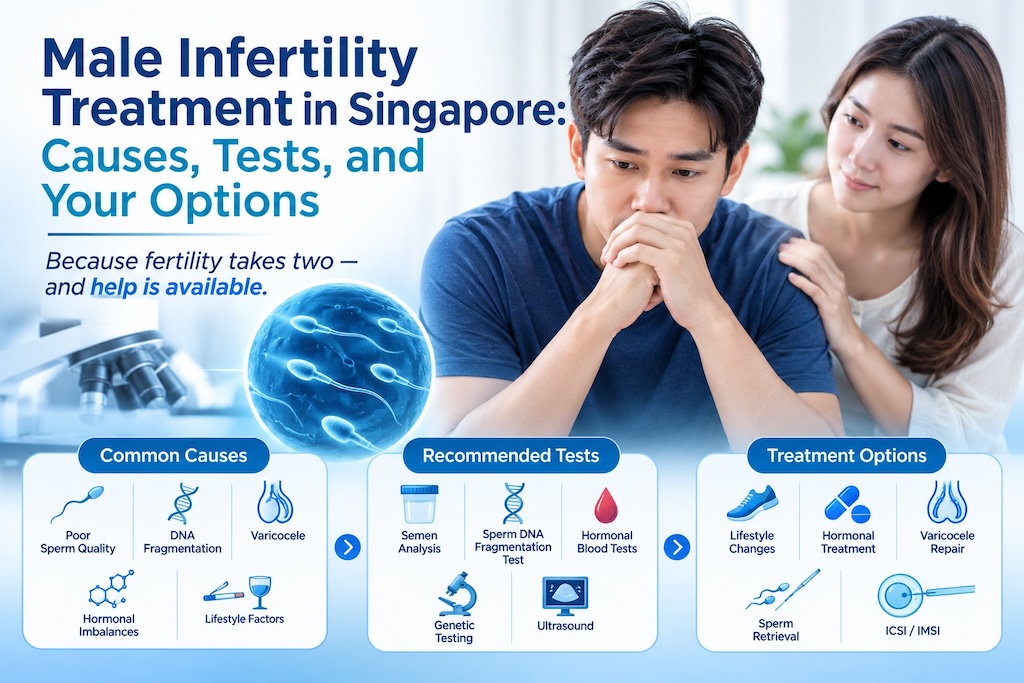
Fertility is often talked about as a women’s health issue, yet it takes two to conceive. Male factors contribute to around half of all infertility cases, and many men have no symptoms at all until they and their partner start trying for a baby.
Learning that sperm health may be part of the picture can feel unexpected, but it’s more common than most people think. The reassuring part is that a male infertility assessment usually begins with a straightforward semen analysis, and many causes can be treated or managed.
Below, we cover the common causes of male infertility, the tests you can expect, and the treatment options available in Singapore.
What Is Male Infertility?
Male infertility means a man has difficulty causing a pregnancy despite regular, unprotected intercourse with a fertile partner. It can come from problems with sperm production (such as low sperm count or poor sperm quality), sperm function (poor movement or shape), sperm delivery (blockages or ejaculation problems), or hormonal imbalances.
A semen analysis is usually the first test recommended for the male partner. It looks at sperm count, movement (motility) and shape (morphology) to help assess fertility.
Common Causes of Male Infertility
1. Sperm Quality Issues
Low sperm count (oligospermia) means there are fewer sperm than normal in the ejaculate. Poor motility means the sperm don’t swim well enough to reach the egg. Abnormal morphology means the sperm have irregular shapes, which can affect their ability to fertilise an egg. These issues can be linked to hormonal imbalances, genetics, lifestyle factors or medical conditions.
2. Sperm DNA Fragmentation
This is a deeper level of sperm health that a standard semen analysis can’t detect. Sperm DNA fragmentation refers to damage or breaks in the genetic material inside the sperm. Sperm can look normal under a microscope and still carry damaged DNA, and higher levels of fragmentation have been associated with poorer embryo development, implantation difficulties and miscarriage.
Several factors may contribute, including smoking or vaping, frequent alcohol consumption, prolonged heat exposure (such as hot baths, laptops on laps or tight clothing), varicocele, infections and advancing age.
3. Azoospermia (No Sperm in the Ejaculate)
Azoospermia is the complete absence of sperm in the ejaculate. It affects about 1% of men globally and is one of the more severe forms of male infertility. There are two types.
Obstructive azoospermia: Sperm production is normal, but a blockage stops sperm from being released. Common causes include a previous vasectomy, infections, or congenital absence of the vas deferens.
Non-obstructive azoospermia: Sperm production is reduced or absent. Causes include genetic conditions such as Klinefelter syndrome, hormonal imbalances, previous chemotherapy or undescended testicles.
4. Varicocele
A varicocele is an enlarged vein in the scrotum that can raise the temperature there and affect sperm production. It’s a common cause of male infertility and, in some cases, can be corrected.
5. Hormonal Imbalances
Low testosterone, pituitary hormone problems, high prolactin or thyroid conditions can all affect sperm production.
6. Lifestyle and Environmental Factors
Smoking, heavy alcohol use, obesity, chronic stress, poor sleep and heat exposure can all affect sperm quality.
Common Tests for Male Infertility
- Semen analysis. This is usually the first test. It measures sperm concentration (count), motility (movement), morphology (shape) and semen volume.
- Sperm DNA fragmentation test. This may be recommended when the semen analysis is normal but conception isn’t happening, or after recurrent miscarriage, several unsuccessful IUI or IVF cycles, or poor embryo development. It may also be considered if there are known risk factors such as varicocele, smoking or older age.
- Hormonal blood tests. These measure hormones such as FSH, LH, testosterone and prolactin to check for hormonal causes of low sperm count.
- Genetic testing. This may be advised for men with non-obstructive azoospermia, to check for conditions such as Klinefelter syndrome or Y chromosome microdeletions.
- Ultrasound. A scrotal ultrasound can detect varicoceles, blockages or other structural issues.
Male Infertility Treatment Options in Singapore
1. Lifestyle Changes
Lifestyle changes are often the first step. Your doctor may suggest losing weight if you’re overweight, quitting smoking and vaping, cutting back on alcohol, exercising regularly in moderation, avoiding heat exposure to the scrotum, and improving your sleep and stress management. These changes may help improve sperm quality over time.
2. Hormonal Treatment
Hormonal treatment is only suitable when tests have identified a hormonal imbalance. In these cases, your doctor may prescribe medication to help regulate your hormone levels. The choice depends on your test results and medical history.
3. Varicocele Repair
Surgical correction of a varicocele may improve semen quality in some men and may be recommended before fertility treatment.
4. Sperm Retrieval (for Azoospermia)
For men with no sperm in the ejaculate, it may be possible to retrieve sperm surgically, either from the epididymis (PESA, or Percutaneous Epididymal Sperm Aspiration) or from the testis (TESA, or Testicular Sperm Aspiration). Your specialist will advise which approach suits your condition. Retrieved sperm can then be used with ICSI to fertilise eggs.
5. Assisted Reproductive Techniques
Intracytoplasmic Sperm Injection (ICSI): A single sperm is injected directly into an egg. It’s often used for male factor infertility, including low sperm count, poor motility, or when sperm has been retrieved surgically.
Intracytoplasmic Morphologically Selected Sperm Injection (IMSI): This uses a much higher magnification than standard ICSI to help select sperm based on their shape and structure. It may be considered for patients with poor sperm quality, sperm DNA fragmentation or previous unsuccessful IVF cycles. Whether IMSI is suitable depends on your individual circumstances, and your doctor can explain what the current evidence shows.
When to Seek Help
Infertility evaluation is generally recommended after 12 months of regular, unprotected intercourse. You may wish to seek help sooner if you have known risk factors such as varicocele, previous genital surgery or cancer treatment. Earlier assessment is also advised if the female partner is over 35 (usually after 6 months).
Taking the First Step
Male infertility is common, and many causes can be treated or managed. A proper assessment can give you answers and help guide your next steps.
At Alpha IVF Singapore, we offer male fertility assessments, including semen analysis and sperm DNA fragmentation testing, as well as treatments such as ICSI and IMSI. Our specialists will explain your results and discuss a plan suited to you.
Concerned about male fertility? Book a male fertility assessment at Alpha IVF Singapore. Our team will take you through the process and help you explore your options.

Medically Reviewed By: Dr Yu Su Ling, Consultant Obstetrician & Gynaecologist and Fertility Specialist at Alpha IVF & Women's Specialists Centre, where she also serves as Clinical Governance Officer. Dr Yu specialises in IVF, infertility, gynaecological endocrinology, and menopause management. Her research interests include intrafallopian tube catheterisation, growth hormone augmentation in IVF, and ovarian tissue transplantation.
Disclaimer: This article is for general information only and doesn’t constitute medical advice. Please consult a qualified fertility specialist for advice specific to your situation.










Leave a Reply
You must be logged in to post a comment.