For many women, receiving a diagnosis of endometriosis can raise concerns about future fertility.
One of the most common questions patients ask is whether endometriosis will affect their ability to conceive and what treatment options may be available if they are planning for pregnancy.
While endometriosis can be associated with fertility challenges in some women, every individual’s experience is different. Understanding how endometriosis may affect fertility and the available treatment approaches can help patients make more informed decisions together with their healthcare team.
What Is Endometriosis?
Endometriosis is a condition where tissue similar to the lining of the uterus grows outside the uterus. These growths may be found on the ovaries, fallopian tubes, pelvic lining and other surrounding structures.
The condition can affect women differently. Some women experience symptoms such as painful periods, pelvic pain or discomfort during intercourse, while others may have few or no symptoms at all.
Because symptoms can vary widely, endometriosis may sometimes remain undiagnosed until investigations are carried out for fertility concerns or other gynaecological symptoms.
How Can Endometriosis Affect Fertility?
Not all women with endometriosis experience difficulty conceiving. However, depending on the location and extent of the condition, fertility may be affected in several ways.
Endometriosis can lead to inflammation within the pelvis, which may influence the environment in which fertilisation and implantation occur. In some cases, scar tissue or adhesions may affect the normal function of the fallopian tubes, ovaries or surrounding pelvic organs.
Ovarian cysts associated with endometriosis, known as endometriomas, may also affect ovarian function in certain individuals. The impact on fertility varies from person to person and depends on multiple factors, including age, ovarian reserve and the severity of the condition.
Understanding the Severity of Endometriosis
Endometriosis is commonly classified into different stages based on the extent of disease present.
The stage of endometriosis may provide useful information about the condition, but it does not always predict a woman’s ability to conceive. Some women with mild endometriosis may experience fertility difficulties, while others with more extensive disease may still achieve pregnancy naturally.
For this reason, fertility specialists consider the overall clinical picture rather than relying solely
on disease stage when discussing treatment options.
What Treatment Options Are Available for Women Planning Pregnancy?
Treatment recommendations for endometriosis are highly individualised and depend on factors such as symptoms, age, fertility goals, ovarian reserve and previous treatment history.
For women who are planning pregnancy, treatment approaches may involve monitoring, surgical management, assisted reproductive techniques such as intrauterine insemination (IUI) or in vitro fertilisation (IVF), or a combination of these approaches.
The most appropriate option depends on each patient’s circumstances and should be discussed with a healthcare professional familiar with both endometriosis and fertility care.
When Might Surgery Be Considered?
Surgery may be considered for selected patients with endometriosis, particularly when symptoms such as pelvic pain significantly affect quality of life or when endometriosis-related cysts and adhesions require further assessment and management.
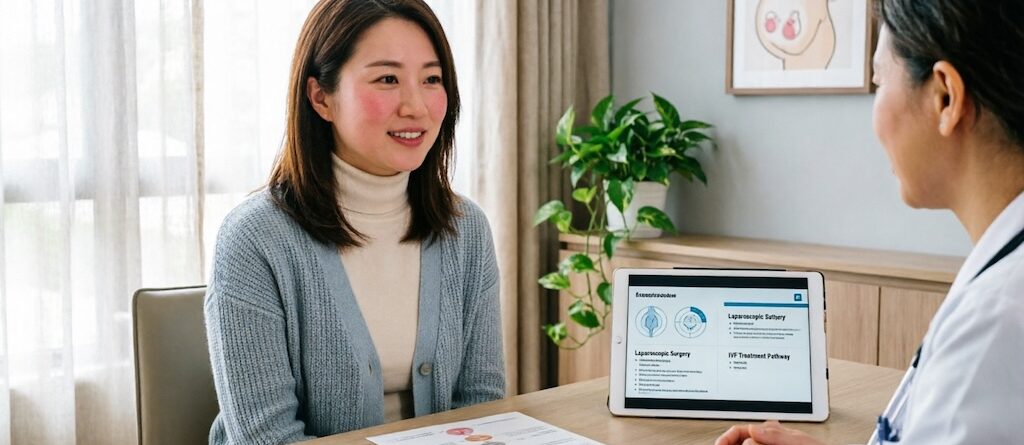
The most common surgical approach is laparoscopy, a minimally invasive procedure that allows the surgeon to diagnose and treat endometriosis through small incisions.
For some women, surgery may form part of an overall fertility management plan. However, the potential benefits and considerations should be carefully discussed with a specialist, especially when ovarian function and future fertility are important concerns.
What Is the Role of IVF in Endometriosis?
IVF is one of the fertility treatment options that may be discussed with women who have endometriosis and are experiencing difficulty conceiving.
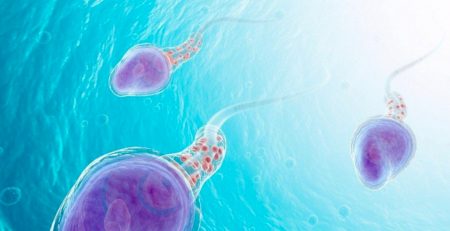
During IVF, eggs are collected from the ovaries, fertilised in the laboratory and developed into embryos before transfer into the uterus. IVF may help overcome some fertility challenges associated with endometriosis, although suitability varies according to individual circumstances.
The decision to proceed with IVF depends on multiple factors, including age, fertility history, ovarian reserve, sperm factors and previous treatment outcomes.
Is Surgery or IVF Better?
There is no single answer that applies to every patient.
Some women may benefit from surgical management before attempting conception, while others may be advised to consider assisted reproductive treatment as part of their fertility journey. In certain situations, both approaches may play a role at different stages of treatment.
Because endometriosis affects each individual differently, treatment decisions are typically made after a comprehensive assessment of medical history, symptoms, fertility investigations and reproductive goals.
There are concerns that removing endometriotic cyst from from the ovary can reduce the number of follicles in the ovary.
Looking Beyond Treatment Choices
When discussing endometriosis and fertility, it is important to remember that treatment decisions are not based on a diagnosis alone.
Age, ovarian reserve, reproductive plans, symptom severity and overall health all contribute to determining the most appropriate approach. Open communication with a fertility specialist can help patients better understand their options and develop realistic expectations for their fertility journey.
Final Takeaway
Endometriosis is a common gynaecological condition that may affect fertility in some women, but it does not necessarily prevent pregnancy.
A range of treatment options may be considered depending on individual circumstances, including surgical management and assisted reproductive treatments such as IVF. The most suitable approach varies from person to person and should take into account both fertility goals and overall wellbeing.
For women living with endometriosis, seeking timely medical advice can help provide clarity, support informed decision-making and ensure that treatment plans are tailored to their individual needs.