

When going through IVF, many patients naturally wonder “Is there a way to better understand the health of an embryo before transfer?”
This is where Pre-implantation Genetic Testing (PGT) comes into the conversation.
It is often described as an advanced step in IVF, but it’s also one of the most commonly misunderstood aspects of fertility treatment, especially in Singapore.
What is PGT in Simple Terms?
Pre-implantation Genetic Testing (PGT) is a laboratory technique used during IVF to analyse embryos for specific genetic or chromosomal conditions before transfer.
During an IVF cycle, embryos are created in the lab. At a certain stage of development, a small number of cells may be carefully taken from the embryo and sent for genetic analysis.
The goal is not to “improve” the embryo, but to provide additional information that may help doctors and patients make more informed decisions about embryo transfer.
A Quick but Important Note about PGT in Singapore
In some countries, PGT may be offered more routinely as an optional add-on to IVF.
However, in Singapore, the use of PGT is regulated by the Ministry of Health and is generally not offered as a routine or elective procedure.
PGT is typically considered only in specific medical situations and may be carried out at licensed centres with appropriate approvals.
This means that not every patient undergoing IVF will require or be suitable for PGT in Singapore.
The Different Types of PGT
PGT is not a single test — it refers to a group of tests designed for different purposes.
1. PGT-A (for chromosomal number)
PGT-A looks at whether an embryo has the expected number of chromosomes.
Humans typically have 46 chromosomes. In some cases, embryos may have missing or extra chromosomes, a condition known as aneuploidy.
Chromosomal differences may affect the likelihood of implantation or may be associated with miscarriage.
PGT-A may be discussed in certain situations, such as advanced maternal age, recurrent pregnancy loss, or repeated IVF cycles without success.
2. PGT-M (for inherited genetic conditions)
PGT-M is used when there is a known risk of a specific inherited condition within a family.
For example, conditions such as thalassaemia, which is relatively more common in Singapore, may be identified through prior screening.
In such cases, PGT-M allows embryos to be tested for that specific condition, which may help support decision-making on embryo transfer.
This process is more complex and usually involves genetic counselling and preparation before the IVF cycle.
3. PGT-SR (for chromosomal structural changes)
PGT-SR is used in situations where one partner carries a structural rearrangement of chromosomes, such as a translocation.
While the individual may be healthy, these rearrangements can sometimes affect embryo development and may be associated with an increased likelihood of miscarriage.
PGT-SR helps identify embryos with balanced chromosomal structure for consideration in transfer.
How PGT Fits into the IVF Process
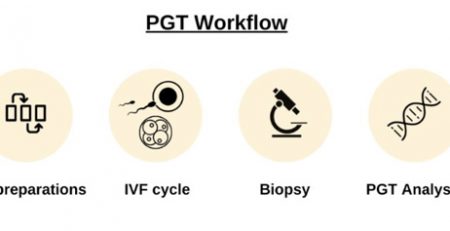
If PGT is recommended, it is incorporated into the IVF process after embryos have developed in the laboratory.
A few cells were biopsied from each embryo, and the embryos are typically frozen while waiting for test results. Transfer is then planned in a subsequent cycle based on the findings.
What PGT May Help with?
For selected patients, PGT may provide additional information that can be helpful in certain situations.
This may include:
- Understanding the chromosomal status of embryos
- Identifying embryos with known genetic conditions
- Supporting clinical decision-making in more complex fertility cases
However, it is important to understand that PGT does not guarantee pregnancy or a successful outcome, as implantation and pregnancy depend on multiple factors.
Final Takeaway
Pre-implantation Genetic Testing is an advanced tool within IVF that can provide additional insights in selected cases.
While PGT may be helpful in certain situations, it is not necessary for everyone. In Singapore, its use is carefully regulated and typically considered only for selected medical indications, rather than as a routine step in IVF.
For many patients, understanding what PGT is — and what it is not — can help set realistic expectations when exploring fertility treatment options.








Leave a Reply
You must be logged in to post a comment.